
As local AI applications continue to grow, memory has become one of the key factors affecting AI PC performance. Running large language models, AI image generation tools, and other demanding workloads requires more than powerful processors — it also requires an efficient way to manage memory resources.
For many AI workloads, the challenge is not only computing power but also available GPU memory. Traditional systems with limited VRAM may struggle when AI models require more memory than the graphics processor can provide.
This is where unified memory architecture becomes increasingly important. By allowing different processing units to access a shared memory pool, modern AI PCs can provide more flexible memory management for local AI applications.
What Is Unified Memory?
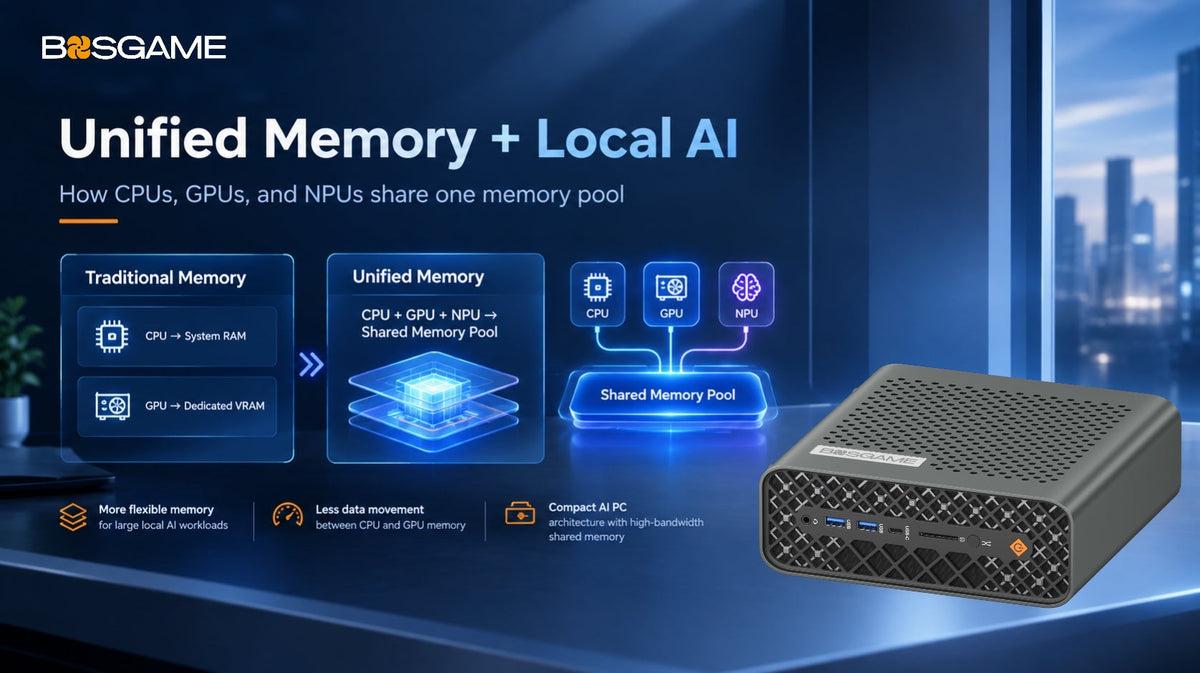
Unified memory is a memory architecture that allows the CPU, GPU, and NPU to access a shared memory pool based on system design and workload requirements.
In a traditional PC with a dedicated graphics card, memory is separated into different areas. The CPU uses system RAM, while the GPU uses its own dedicated VRAM.
This separation works well for many traditional applications, but it can become a limitation when AI workloads require large amounts of memory.
With unified memory, the CPU, GPU, and NPU can work with the same memory resource, creating a more flexible architecture for memory-intensive applications.
Unified Memory vs. Traditional Memory Architecture
Traditional memory architecture
CPU → System RAM
GPU → Dedicated VRAM
Unified memory architecture
CPU + GPU + NPU → Shared Memory Pool
The main difference is how memory resources are organized. Instead of maintaining separate memory pools, unified memory allows supported computing units to access shared resources, reducing the limitations caused by fixed memory separation.
Why Does Unified Memory Matter for Local AI?
Supporting Larger AI Models
Local AI workloads often require significant memory capacity. Large language models, image-generation models, and other AI applications can quickly exceed the available VRAM of conventional GPU systems.
A larger shared memory pool provides more flexibility for running memory-intensive workloads locally, allowing compact AI PCs to handle a wider range of models and applications.
This is especially valuable for users who prefer local AI processing instead of depending entirely on cloud-based services.
Improving Memory Flexibility Between Computing Units
In traditional systems, data may need to move between system memory and GPU memory when different processors need access to the same information.
Unified memory reduces this separation by allowing CPU, GPU, and NPU resources to access shared memory. Depending on software support and hardware design, this can improve memory efficiency for certain AI workloads.
A Better Solution for Compact AI PCs
Mini PCs and compact AI systems face unique design challenges. Limited physical space makes it difficult to include large dedicated memory solutions while maintaining a small form factor.
Unified memory provides another approach by combining high-capacity memory with efficient access between different computing units.
This makes it a valuable architecture for compact AI PCs designed for local AI, content creation, and advanced computing.
Does Unified Memory Always Make AI Faster?
Not necessarily.
Unified memory does not automatically improve every workload. Real-world performance still depends on multiple factors, including processor architecture, GPU capability, memory bandwidth, software optimization, cooling design, and the specific application being used.
The main advantage of unified memory is flexibility. It allows CPU, GPU, and NPU resources to share memory more efficiently when supported by the system architecture.
For local AI workloads, this flexibility can become especially important when memory capacity is the limiting factor.
How BOSGAME AI PCs Use Unified Memory Architecture
BOSGAME AI PCs are designed to support modern AI workloads by combining powerful processors, high-capacity memory configurations, and efficient memory architectures.
By integrating CPU, GPU, and NPU computing with shared memory access, BOSGAME AI PCs provide a compact platform for applications such as local AI inference, AI-assisted creation, software development, and multitasking.
Rather than focusing only on individual hardware specifications, a complete AI PC experience depends on how different components work together — including processing power, memory capacity, bandwidth, and system design.
Conclusion
Unified memory provides AI PCs with a more flexible way to handle memory-intensive workloads.
By allowing CPU, GPU, and NPU resources to access a shared memory pool, this architecture helps compact AI systems support more demanding local AI applications while maintaining an efficient design.
Flexible memory architecture. More possibilities for local AI.

Leave a comment
All comments are moderated before being published.
This site is protected by hCaptcha and the hCaptcha Privacy Policy and Terms of Service apply.