
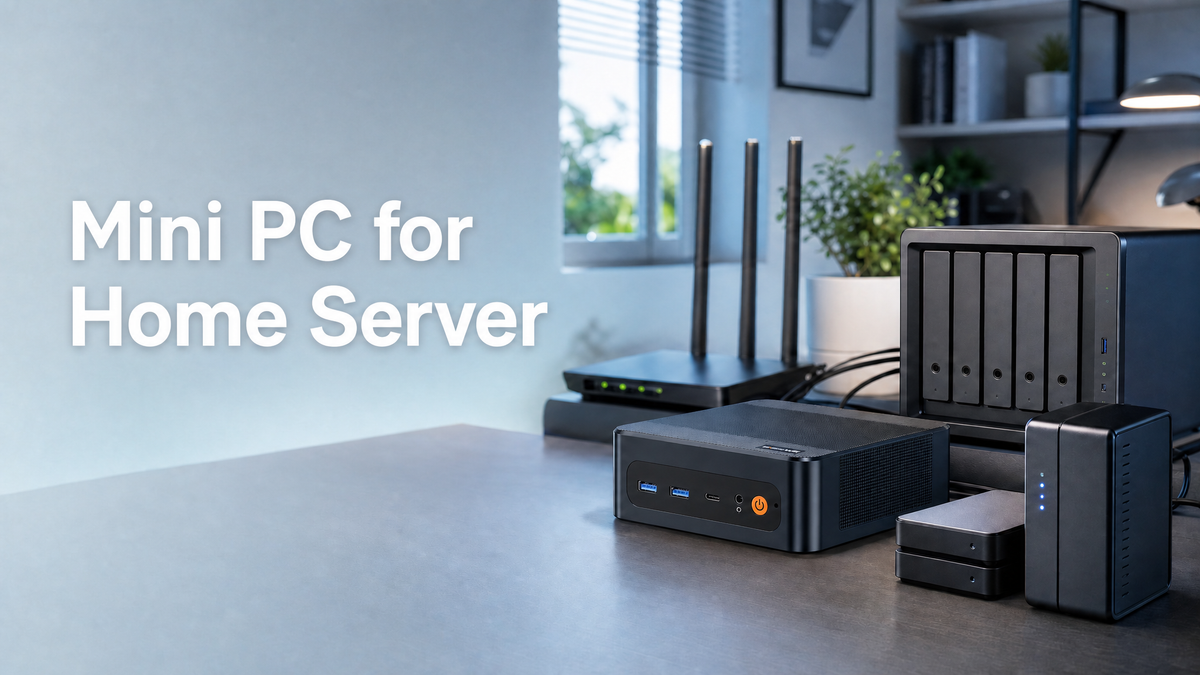
Thinking about building your own home server but don't want a bulky, noisy tower eating up space? A mini PC for home server use has become one of the go-to solutions for home users, delivering enough power to handle file storage, media streaming, smart-home automation, and more — all packed into a small, quiet unit. This guide covers the main benefits of choosing a mini PC as your home server and the most useful ways to put one to work.
Why Choose a Mini PC as a Home Server?
A mini PC for home server use brings together a compact footprint, energy efficiency, quiet performance, solid connectivity, and flexible storage options. Together, these qualities make mini PCs well suited to a wide range of home server needs, from backups and file sharing to streaming media and running smart-home routines.
Compact Footprint
One of the biggest draws of running a mini PC as a home server is how little space it takes up. Unlike a full-size desktop tower, a mini PC tucks easily onto a desk, shelf, TV stand, or network cabinet. That makes it a solid fit for homes where square footage is at a premium. Its small form factor also simplifies cable management, letting you set up a home server without giving over much room to bulky equipment.
Energy Efficiency
Because a home server often stays on around the clock, power draw plays a real role in long-term running costs. A low-power mini PC for home server use can handle tasks like file sharing, backups, media streaming, and home automation while keeping electricity use comparatively modest. Lower power draw also tends to mean less heat output, which can ease cooling demands during nonstop operation.
Quiet Performance
Because a home server typically runs continuously in a living space, noise level matters. A mini PC usually needs less cooling than a full-size desktop, so it can stay fairly quiet even under typical server workloads. That quieter operation matters most when the server sits in a bedroom, home office, or living room. When picking a mini PC for a home server, pay attention to its cooling setup and how the fan behaves under sustained load.
Flexible Storage
Storage room matters for a home server, since photos, videos, backups, and other files add up fast. Depending on the model, a mini PC may support several M.2 SSDs, SATA drives, or external USB storage. Having room to add more storage also makes it easier to scale your server as your data grows.
What Can a Mini PC Home Server Actually Do?
A mini PC for home server use is more capable than most people assume. Paired with the right software, it can run quietly in the background, covering everything from backups to entertainment to smart-home management. Here are some of the most common ways people put a low-power mini PC to work as a home server.
File Storage and Backup
A mini PC for home server use is one of the simplest ways to bring your family's photos, videos, and documents together in one place instead of leaving them spread across various laptops and phones. Depending on your OS and storage setup, you can configure automated backups, storage pools, RAID arrays, and remote access from any device on your network.
Media Streaming
Setting up Plex or Jellyfin on a home server essentially gives you your own private Netflix, letting you stream content you already own to any TV, phone, or tablet in the house. A capable mini PC with a strong integrated GPU can manage multiple 4K transcodes at once, so several people can stream different shows simultaneously — typically while using less power than a full desktop would.
Home Assistant
For a mini PC for home server use, Home Assistant offers a practical way to run your smart home locally. It can handle lights, thermostats, cameras, and sensors while keeping most automations running on your own network. Even when the internet drops, these local routines can keep working, giving you more dependable control over your smart-home devices.
Home Lab and Virtualization
For anyone building IT skills or testing out new software, a mini PC for home server use makes a handy home lab. Platforms like Proxmox or ESXi let you spin up several virtual machines to practice networking, experiment with different operating systems, or mimic real server environments — all safely separate from your everyday devices.
Game Servers
Want to play Minecraft, Valheim, or ARK with friends without dealing with laggy public servers? A home server can run your own private game server around the clock, giving you full say over mods, settings, and who gets access. Since game servers generally call for steady uptime rather than heavy compute power, a mini PC manages the job with ease.
Conclusion
A mini PC for home server use packs surprising versatility into a small, energy-efficient package. Its compact size, low power draw, and quiet performance mean it can run 24/7 without taking over your living space or driving up your power bill. If you're ready to get started, look for a low power mini pc for home server with room for extra storage and reliable connectivity — it's an affordable, beginner-friendly way to build your first setup.

Leave a comment
All comments are moderated before being published.
This site is protected by hCaptcha and the hCaptcha Privacy Policy and Terms of Service apply.