
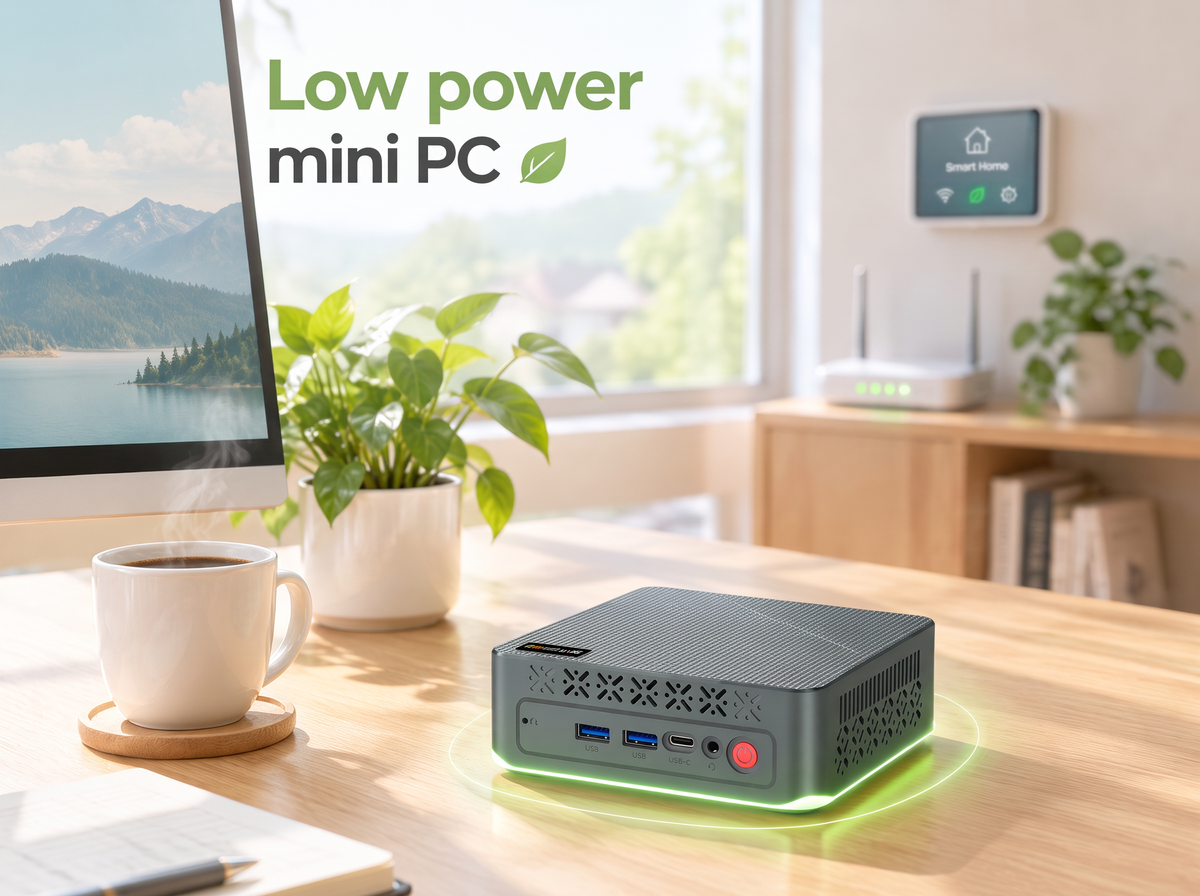
What Is a Low Power Mini PC?
A low power mini PC is a small-form-factor computer built for routine computing while drawing relatively little electricity. It usually relies on an energy-efficient processor, produces minimal heat, and stays quiet during use. That makes it well suited to equipment that never gets switched off, such as home servers, routers, and office workstations.
What Does Low Power Mean in a Mini PC?
A mini PC doesn’t use the same amount of energy all the time. Idle power is what it consumes when switched on but doing almost nothing. Load power is the draw when it runs demanding software, and standby power is the energy used while it rests in a low-power state instead of fully running. A good low power mini PC stays efficient in all three situations.
Why Choose a Low Power Mini PC?
Drawing less power cuts electricity expenses, particularly for machines that work many hours every day. Saving only 1 kWh per day, for instance, comes to roughly 30 kWh each month and 365 kWh across a year. Depending on your local rates, that can add up to a meaningful amount over time. Lower consumption also means less heat, which can reduce cooling demands and let the system run more quietly. Together with their small footprint, these traits make low power mini PCs a sensible pick for home offices, media playback, and light home server duties.
Who Needs a Low Power Mini PC?
This type of machine is most helpful for systems that stay on continuously or carry light workloads for extended periods. Typical examples are home servers, smart home hubs, network appliances, and office computers. Which one is right for you comes down to the workload, the performance you need, and how many hours the system stays active.
Home Server and NAS
Maybe you stream media with Plex or Jellyfin, share files, or back up family photos. In any of these cases, a home server can stay busy for hours or run non-stop. A low power mini PC helps limit the energy spent on everyday server tasks, though real consumption still depends on the storage devices, the workload, and whether media transcoding is involved.
Smart Home Hub
Platforms like Home Assistant can run on a mini PC to link your connected devices, handle automations, and keep an eye on your home. These services tend to run around the clock, so a low power mini PC is an ideal host that keeps energy use down over the long term.
Soft Router and Firewall
If pfSense, OPNsense, or OpenWrt manages your home network, the router or firewall must stay online at all times to process traffic and protect your devices. A low power mini PC fits this role well, letting you run your network 24/7 without wasting energy.
Office Computer and Digital Signage
Reception desks, shared workstations, retail displays, and menu boards seldom require strong performance, yet they are often on for many hours daily. The workload is usually light, covering browsing, documents, video calls, or looping content. A low power mini PC copes with this easily while sipping electricity, and the savings grow when you deploy several units. Quiet or nearly silent operation is also a bonus in spaces where customers are present.
Best Low Power Mini PCs from BOSGAME
Not every mini PC is truly low-power. When shopping for a low power mini PC, BOSGAME’s Ecolite series deserves a close look. Its name blends “Eco” and “Lite,” describing energy-saving, lightweight machines made for everyday office tasks rather than heavy workloads. Here is how the individual models compare.
BOSGAME E5
The BOSGAME E5 is a low-power mini PC for daily use, powered by a 4-core, 8-thread processor from the 5000 Series. In our own power tests, it used only 5.2–6.2W at idle, 8.5–9.5W while browsing the web and playing video, and about 9W for office work. This low idle draw is a real advantage if you need the mini PC to stay on for long stretches.
BOSGAME E6 ECO
The BOSGAME E6 ECO is a strong match for scenarios that call for 24/7 operation. Our tests recorded about 7W at idle and around 9W when streaming video. Even with the CPU and GPU stressed together, consumption stayed under 30W, at roughly 28W. Left idle around the clock, it would use only about 61 kWh per year. Its compact size, dual Ethernet ports, and Wi-Fi 7 support also make it a great fit as a home office device, smart home hub, or soft router.
Note: The power figures come from our own testing and can change with configuration, operating system, connected devices, and workload. Results in your own setup may differ.
Conclusion
More and more of our digital lives depend on devices that never turn off, from smart homes to personal servers and home networks. In that world, efficiency matters as much as raw speed. A low power mini PC proves that a dependable computer doesn’t have to be large, noisy, or power-hungry. Picking one may seem like a minor choice, but across thousands of hours of calm, steady running, it becomes a smarter way to power the things you count on every day.

Leave a comment
All comments are moderated before being published.
This site is protected by hCaptcha and the hCaptcha Privacy Policy and Terms of Service apply.